
Introduction
Voice AI is rapidly transforming enterprise contact centers by enabling intelligent self-service, automated customer engagement, faster issue resolution, and around-the-clock support. Organizations across industries are deploying AI-powered voice assistants to improve customer experience, increase operational efficiency, and reduce service costs.
However, while the business benefits are significant, the security implications are often underestimated.
Many enterprises approach Voice AI as a customer experience initiative rather than a cybersecurity initiative. As a result, security controls are frequently added after deployment instead of being embedded into the architecture from the beginning. This creates a growing gap between AI adoption and security readiness.
At the same time, advances in synthetic voice technology, deepfake audio generation, and AI-powered impersonation are making it easier for attackers to mimic legitimate customers, bypass traditional verification processes, and exploit weaknesses in automated interactions. What once required sophisticated social engineering can now be executed at scale using AI-generated identities and cloned voices.
This creates an entirely new category of contact center security risk that exists at the intersection of customer experience operations, identity management, fraud prevention, and enterprise cybersecurity. Organizations increasingly view AI Services as an Enterprise Capability Layer rather than isolated technology projects, making governance and security foundational requirements.
As enterprises continue expanding Voice AI capabilities, fraud awareness and prevention architecture can no longer be considered optional. Security-first Voice AI deployment has become a critical requirement for protecting customers, maintaining regulatory compliance, and preserving trust in AI-driven service channels. This evolution is supported by enterprise AI services that combine security, governance, automation, and intelligent customer engagement into a unified operational framework.
What Is Traditional Contact Center Security vs Voice AI Fraud Risk?
Traditional contact center security focuses on protecting human-operated customer service environments through access controls, call recording policies, data privacy frameworks, and agent authentication mechanisms.
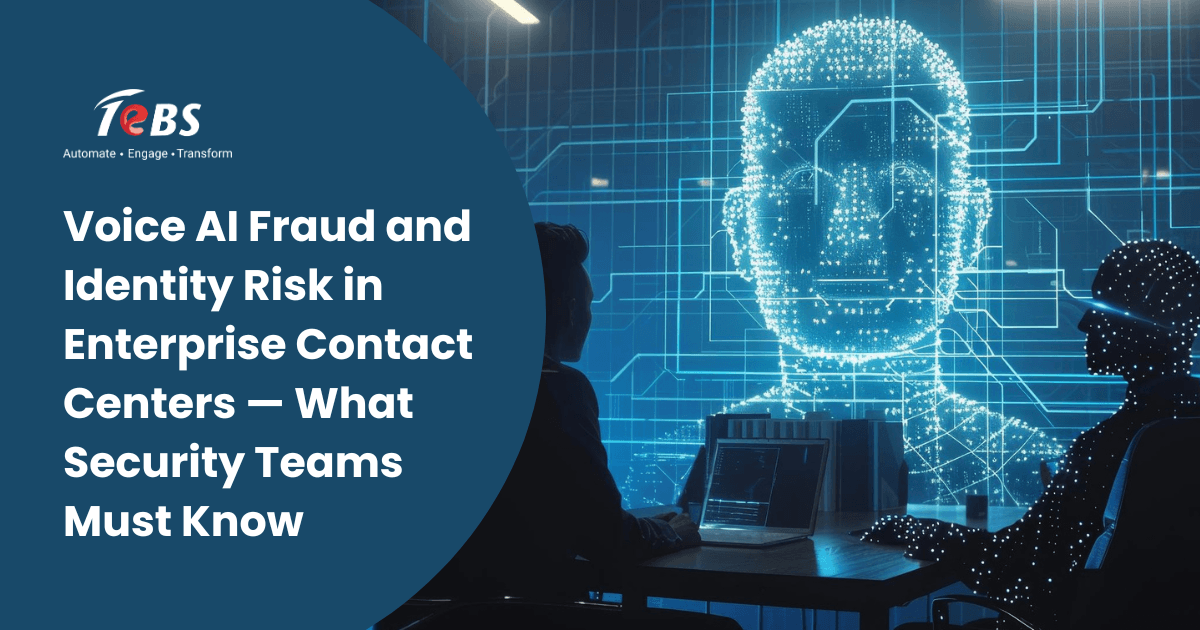
Voice AI fraud risk introduces a significantly broader threat landscape where AI-generated voice cloning, synthetic identities, deepfake audio, and autonomous AI impersonation attacks exploit authentication models that were originally designed for human interactions rather than AI-powered conversations.
The challenge is not that existing security frameworks are ineffective. The challenge is that they were never designed to defend against AI-generated identities operating at machine speed and scale.
Why Voice AI Creates New Enterprise Security Vulnerabilities
AI-Generated Voice Cloning Enables Synthetic Impersonation at Scale
Modern voice synthesis platforms can recreate human speech patterns with remarkable accuracy using only short audio samples. Attackers can leverage publicly available recordings, social media content, or previously captured audio to create convincing synthetic voices.
These cloned voices can then be used during customer service interactions to impersonate legitimate account holders and gain unauthorized access to sensitive information.
Weak Identity Verification in AI Self-Service Flows Creates Authentication Gaps
Many AI-powered contact center implementations prioritize frictionless customer experiences. While this improves convenience, it can inadvertently weaken verification procedures.
If authentication relies solely on easily obtainable personal information such as names, dates of birth, account numbers, or addresses, attackers may successfully bypass security checks using stolen or synthetic identities.
Real-Time Voice AI Systems Process Sensitive Data Faster
Traditional agent-assisted interactions naturally introduce verification checkpoints and behavioral observations. AI systems, by contrast, process requests rapidly and consistently.
While efficiency is beneficial, it also means fraudulent access attempts can move through customer journeys faster if adequate risk controls are not present.
Agent-to-Agent AI Interactions Introduce New Trust Boundaries
As AI ecosystems mature, enterprises are beginning to support interactions between customer-side AI assistants and enterprise AI systems.
These machine-to-machine engagements create new challenges around authorization, delegation, identity validation, and trust management. Security teams must determine how AI agents authenticate themselves and what permissions they are allowed to exercise on behalf of users.
Compliance Requirements Continue to Evolve
Regulatory frameworks are still adapting to AI-enabled customer interactions. Organizations must navigate emerging expectations around biometric data protection, AI explainability, customer consent, automated decision-making, and model governance.
Failure to prepare for evolving regulations can expose enterprises to compliance and reputational risks.
Security Teams Are Often Involved Too Late
In many organizations, Voice AI deployments are initiated by customer experience, digital transformation, or operations teams. Security teams frequently become involved only after incidents, audit findings, or regulatory concerns emerge.
Embedding cybersecurity expertise during design and implementation stages significantly reduces long-term risk. Comprehensive AI cloud security services help enterprises establish proactive monitoring, governance controls, and threat detection capabilities across Voice AI environments.
What Defines a Voice AI Security-Ready Contact Center?
The evolution of Voice AI requires a shift from perimeter-focused security toward identity-first, AI-aware protection models.
Instead of assuming callers are legitimate until proven otherwise, modern architectures continuously validate identity, assess risk, monitor behavior, and adapt security controls throughout interactions.
Core Security Capabilities
A Voice AI security-ready contact center should include:- AI-powered voice biometrics and behavioral identity verification
- Synthetic voice detection embedded into live call workflows
- Risk-based authentication that adjusts verification requirements dynamically
- Continuous monitoring of AI agent activities and decision patterns
- Human-in-the-loop oversight for sensitive or high-risk transactions
- Comprehensive audit trails supporting investigation and compliance reviews
- Integration with enterprise identity governance frameworks
- Real-time fraud intelligence and anomaly detection capabilities
Architecture Overview: Basic Contact Center Security vs Voice AI Security Architecture
The security model required for Voice AI differs significantly from traditional contact center environments.
| Traditional Contact Center Security | Voice AI Security Architecture | Business Outcome |
| Agent-managed authentication | AI voice biometric verification | Stronger identity assurance |
| Perimeter access controls | Synthetic voice detection layer | Fraud loss reduction |
| Reactive incident response | Real-time AI anomaly monitoring | Earlier threat detection |
| Standard audit logging | AI decision explainability trails | Regulatory defensibility |
| Static customer verification questions | Adaptive risk-based authentication | Reduced account takeover risk |
| Manual fraud investigation processes | Automated fraud signal correlation | Faster incident response |
| Agent observation of suspicious behavior | Continuous behavioral analytics | Improved threat visibility |
| Separate security and CX operations | Integrated AI governance model | Better organizational alignment |
| Periodic compliance reviews | Continuous compliance monitoring | Improved regulatory readiness |
| Transaction-focused verification | Continuous identity validation | Higher customer trust |
Core AI Capabilities Powering Voice Fraud Prevention
Real-Time Voice Biometric Authentication and Liveness Detection
Voice biometrics analyze unique vocal characteristics to verify identity. Liveness detection adds another layer by determining whether a voice originates from a real person rather than a recording or synthetic audio source.
Together, these technologies help reduce impersonation attempts while maintaining a seamless customer experience.
Machine Learning Models for Synthetic Voice Detection
Advanced AI models can identify characteristics commonly associated with cloned voices and deepfake audio.
These systems analyze acoustic patterns, signal artifacts, speech generation markers, and behavioral inconsistencies that may indicate synthetic content.
Behavioral Analytics for Anomaly Detection
Behavioral analysis extends beyond voice recognition.
AI systems can evaluate interaction patterns, transaction behaviors, conversational characteristics, location signals, device information, and account activity to identify unusual behavior that may indicate fraud. Similar behavioral monitoring models discussed in AI-driven transaction intelligence help enterprises identify fraud patterns, anomalous behavior, and emerging security threats in real time.
Risk-Based Authentication Engines
Not every interaction requires the same level of verification.
Risk-based authentication engines evaluate multiple signals during conversations and automatically trigger additional verification steps when risk thresholds are exceeded. Microsoft Entra ID Protection demonstrates how risk-based authentication can continuously evaluate user behavior, identity signals, and threat indicators to strengthen authentication decisions while minimizing friction for legitimate users.
This approach strengthens security while minimizing customer friction. Intelligent AI automation services enable dynamic authentication workflows that automatically adjust verification requirements based on risk signals and behavioral indicators.
AI Decision Logging and Explainability
Organizations must be able to demonstrate how authentication decisions were reached.
Comprehensive logging and explainability frameworks provide visibility into AI-generated decisions, supporting investigations, audits, and regulatory reporting requirements.
Integration with Enterprise Identity and Access Management
Voice AI security should not operate as an isolated technology stack.
Effective implementations integrate with enterprise Identity and Access Management (IAM) platforms to ensure consistent authentication policies, centralized governance, and unified access controls across digital channels. Modern AI enterprise integration services help connect identity platforms, fraud monitoring systems, authentication frameworks, and compliance controls across enterprise ecosystems.
Business Impact of Voice AI Security Architecture
Organizations that invest in dedicated Voice AI security capabilities gain advantages that extend beyond fraud prevention.
Reduced Fraud Losses
Voice cloning, synthetic identities, and account takeover attempts can result in significant financial losses. Advanced authentication and fraud detection capabilities help reduce exposure to these risks.
Greater Regulatory Confidence
Documented authentication controls, explainable AI decisions, and comprehensive audit trails support regulatory reviews and compliance assessments.Improved Customer Trust
Customers increasingly expect secure digital experiences. Strong identity verification mechanisms help build confidence while preserving convenience.Faster Detection of Emerging Threats
Continuous monitoring enables organizations to identify suspicious AI activity before attackers can exploit vulnerabilities at scale.Compliance Readiness
As AI-specific regulations continue evolving across global markets, organizations with established governance frameworks will be better positioned to meet new requirements.Stronger Security Governance
Integrating cybersecurity teams into contact center AI initiatives ensures security considerations are incorporated from deployment through ongoing operations.
</section>
<section aria-label=”Security governance compliance and regulatory considerations for voice AI deployments”>
Security and Compliance Considerations
Organizations deploying Voice AI should establish governance frameworks that address both current and emerging regulatory expectations. Strong operational AI governance frameworks are essential for maintaining explainability, accountability, compliance, and trust across AI-powered authentication environments.
Alignment with Singapore MAS Technology Risk Guidelines
Enterprises operating in Singapore should ensure Voice AI deployments align with technology risk management expectations, particularly regarding customer authentication, operational resilience, risk governance, and monitoring of AI-assisted interactions.Voice Biometric Data Governance and Consent Management
Voice biometrics involve the collection and processing of sensitive identity-related information. Organizations must implement appropriate consent, retention, storage, and access management controls.EU AI Act Implications
For enterprises serving European customers, the EU AI Act introduces requirements related to transparency, risk management, automated decision-making oversight, and monitoring of AI systems.
These considerations may extend to sentiment analysis, customer profiling, and agent performance monitoring capabilities.
Explainable Authentication Decisions
Regulators increasingly expect organizations to explain how automated systems make decisions affecting customers.
Voice AI authentication platforms should provide transparency into risk scores, verification outcomes, and escalation triggers.
Role-Based Access Controls
Access to Voice AI security dashboards, biometric data, fraud alerts, and monitoring tools should be governed by role-based permissions and least-privilege principles.Continuous Monitoring for Model Drift
Voice verification models can degrade over time due to evolving speech patterns, environmental conditions, or adversarial tactics.
Regular monitoring helps maintain accuracy, fairness, and effectiveness.
How TeBS Helps Enterprises Secure Voice AI Contact Center Deployments
Total eBiz Solutions (TeBS) helps organizations design and implement security-first Voice AI contact center environments that balance customer experience, compliance, and enterprise risk management.
TeBS supports enterprises through:
- Voice AI security risk assessments across existing contact center environments
- Authentication architecture design incorporating voice biometrics and synthetic voice detection
- Integration with enterprise IAM, security, and compliance platforms
- Governance, explainability, and audit framework implementation
- Security monitoring and continuous optimization of AI-powered customer interactions
- Risk management alignment with organizational cybersecurity and compliance requirements
- Deployment strategies that embed security controls from the beginning rather than after incidents occur
By combining customer experience innovation with enterprise-grade security controls, TeBS helps organizations confidently scale Voice AI adoption while reducing fraud and identity-related risks.
Conclusion
Voice AI is becoming a foundational component of modern enterprise contact centers, but its benefits must be balanced with a realistic understanding of the evolving threat landscape.
Synthetic voice technology, AI impersonation, deepfake audio, and automated identity attacks are reshaping how fraud occurs within customer service environments. Traditional contact center security models alone are no longer sufficient to address these risks.
Organizations that treat Voice AI fraud and identity risk as a first-class security priority build contact center ecosystems that are more resilient, compliant, and trusted by both customers and regulators. By implementing identity-first security architectures, AI-powered fraud detection, explainable authentication controls, and continuous governance frameworks, enterprises can confidently deploy Voice AI without compromising security.
To learn how your organization can build a secure and compliant Voice AI contact center strategy, contact TeBS at sales@totalebizsolutions.com.
FAQs
1. What is voice AI fraud in enterprise contact centers?
Voice AI fraud refers to the fraudulent use of AI-generated synthetic voices, deepfake audio, or identity impersonation techniques to exploit authentication weaknesses in AI-powered contact center interactions.
2. Why does Voice AI expand the contact center attack surface?
Voice AI reduces friction within self-service customer interactions. While this improves efficiency, it can also reduce verification barriers that previously slowed or prevented fraudulent access attempts.
3. Can AI detect synthetic or AI-generated voice during live calls?
Yes. Real-time liveness detection technologies and synthetic audio classification models can identify many AI-generated voice patterns during active customer interactions.
4. What regulations govern Voice AI security in Singapore?
Singapore’s MAS Technology Risk Management guidelines provide relevant expectations for AI-assisted customer interactions. Organizations serving global markets should also consider requirements introduced under the EU AI Act and other emerging AI governance frameworks.
5. How can enterprises balance security and customer experience in Voice AI channels?
Risk-based authentication enables organizations to apply additional verification only when elevated risk signals are detected, maintaining a low-friction experience for legitimate customers while strengthening protection against fraud.
6. How canTeBShelp secure enterprise Voice AI contact center deployments?
TeBS designs Voice AI security architectures that integrate biometric authentication, synthetic voice detection, compliance controls, governance frameworks, auditability, and enterprise identity management to help organizations reduce fraud risk while supporting regulatory compliance.