
Introduction
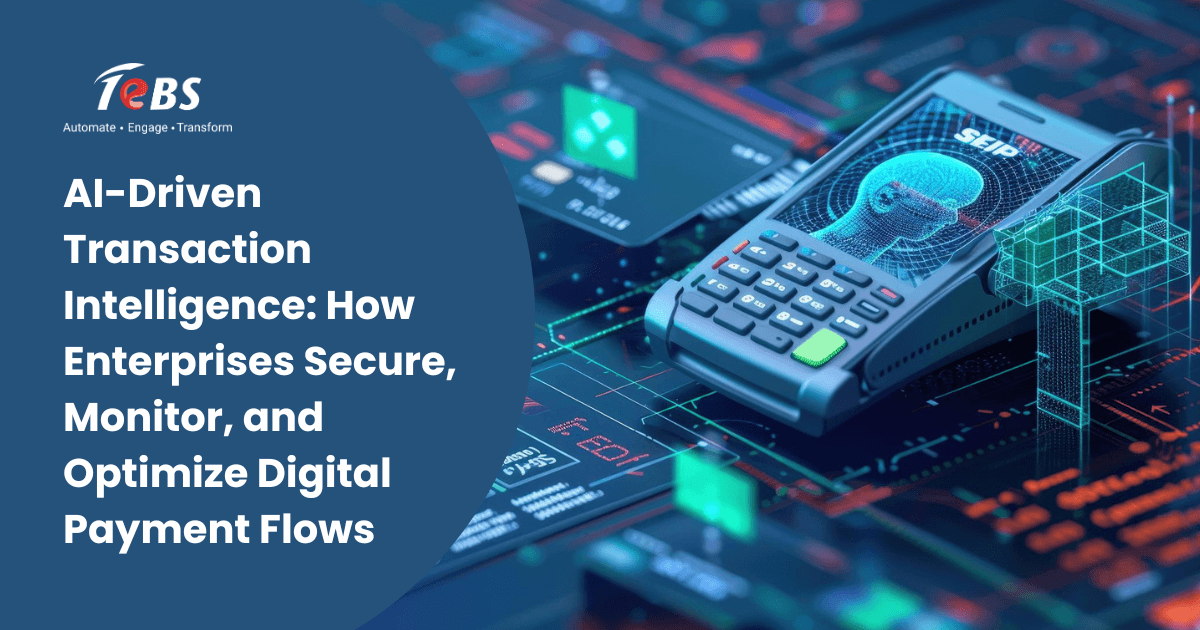
Growing digital adoption has pushed enterprises to process millions of transactions across channels, geographies, and payment methods every day. Along with this scale comes increasing fraud sophistication, stricter regulatory expectations, and rising customer demand for instant, seamless payments. Static controls and manual reviews can no longer keep pace with this complexity. Enterprises now require intelligent systems that can analyze transactions in real time, detect risk as it emerges, and continuously adapt to new threats. This is where AI-driven transaction intelligence becomes essential, transforming payment operations from reactive oversight to proactive control. This evolution requires structured enterprise AI services that embed intelligence, risk management, and compliance directly into payment workflows.
What Is Transaction Intelligence in Enterprise Payments?
Transaction intelligence is the use of advanced analytics and artificial intelligence to continuously monitor, evaluate, and optimize payment transactions across their entire lifecycle, going far beyond basic fraud detection to deliver real-time risk awareness, compliance assurance, and actionable insights. This builds on broader trends explored in AI in payment processing, where artificial intelligence enhances fraud detection and customer experience simultaneously.
Limitations of Traditional Payment Processing
Traditional payment processing systems were designed for predictable transaction volumes and well-defined risk patterns. While they still form the backbone of many enterprise payment environments, their limitations become evident in modern digital ecosystems.
Rule-based fraud checks rely on predefined conditions such as transaction amount thresholds or geographic restrictions. While effective against known fraud patterns, they struggle to detect new or evolving threats and require constant manual updates.
Delayed risk detection is another challenge. Many traditional systems analyze transactions after processing, meaning fraud is identified only once losses have already occurred. This reactive approach exposes enterprises to financial and reputational damage.
High false positives significantly impact both operations and customer experience. Legitimate transactions are often flagged as suspicious, leading to unnecessary declines, manual reviews, and customer frustration.
Limited real-time insights restrict decision-making. Traditional platforms provide fragmented reporting that lacks contextual intelligence, making it difficult for finance, risk, and compliance teams to understand transaction behavior holistically.
Operational inefficiencies arise from heavy reliance on manual intervention, siloed systems, and slow reconciliation processes. These inefficiencies increase processing costs and reduce scalability as transaction volumes grow.
Core Capabilities of AI-Driven Transaction Intelligence
AI-driven transaction intelligence introduces a fundamentally different approach, embedding intelligence directly into payment workflows.
Real-time fraud detection allows transactions to be assessed instantly using machine learning models that evaluate hundreds of variables simultaneously. This enables immediate action before fraudulent payments are completed.
Pattern recognition helps uncover subtle and complex behaviors that traditional rules miss. AI models learn from historical and real-time data to identify anomalies, recurring fraud signatures, and emerging attack vectors. These capabilities reflect the broader role of AI analytics in enterprise decision-making.
Risk scoring assigns dynamic risk levels to each transaction based on behavior, context, and historical trends. This enables differentiated decision-making, such as auto-approvals for low-risk payments and enhanced scrutiny for high-risk ones.
Compliance monitoring becomes continuous rather than periodic. AI systems can automatically check transactions against regulatory requirements, sanctions lists, and internal policies, reducing compliance gaps and manual effort.
Transaction analytics provide deep visibility into payment flows. Enterprises gain insights into transaction success rates, failure patterns, customer behavior, and operational bottlenecks, enabling data-driven optimization. These insights are powered by scalable AI data analytics services that transform raw transaction data into real-time intelligence.
Architecture Overview: Traditional vs AI-Driven Payment Processing
In traditional architectures, payment flows typically move through gateways, basic validation layers, and rule-based checks before settlement, with reporting generated after the fact. Risk assessment and compliance reviews often occur in isolation, limiting their effectiveness.
AI-driven payment processing introduces an intelligent layer within the transaction flow. Payments pass through an AI risk engine that evaluates fraud signals, behavioral patterns, and contextual data in real time. This is followed by automated compliance checks aligned with regulatory and internal requirements. All transaction data and decisions feed into centralized reporting and analytics, creating a continuous feedback loop that improves accuracy over time.
Comparing Traditional and AI-Driven Payment Models
| Traditional Payments | AI-Driven Payments | Business Outcome |
| Static rule-based checks | Adaptive machine learning models | Improved fraud detection accuracy |
| Post-transaction analysis | Real-time transaction evaluation | Reduced fraud losses |
| High manual intervention | Automated risk assessment | Lower operational costs |
| High false positives | Context-aware risk scoring | Higher approval rates |
| Fragmented reporting | Unified transaction analytics | Better decision-making |
| Periodic compliance reviews | Continuous compliance monitoring | Reduced regulatory risk |
| Limited scalability | Scalable AI-driven architecture | Future-ready payment operations |
| Slow response to new threats | Self-learning models | Faster threat mitigation |
Business Impact of AI-Driven Payments
The adoption of AI-driven transaction intelligence delivers measurable benefits across the enterprise.
Reduced fraud losses are achieved through early detection and prevention of fraudulent activities before settlement. AI’s ability to adapt to new fraud patterns significantly lowers financial exposure.
Faster transaction approvals enhance operational efficiency and customer satisfaction. Low-risk transactions move through seamlessly, reducing unnecessary delays and manual reviews.
Improved compliance is driven by continuous monitoring and automated controls that align with regulatory frameworks. This minimizes the risk of penalties, audit issues, and reputational damage.
Better customer experience results from fewer false declines, faster processing, and consistent payment performance. Customers gain confidence in secure, reliable digital payment interactions.
Security & Compliance Considerations
Security and compliance are foundational to any AI-driven payment strategy.
Data encryption ensures that sensitive transaction and customer data is protected both in transit and at rest. Strong encryption practices reduce the risk of data breaches and unauthorized access.
Regulatory compliance is supported through built-in controls aligned with financial regulations, data protection laws, and industry standards. Microsoft’s financial services industry guidance outlines how AI, cloud, and security controls can be designed to support compliance, fraud prevention, and resilient digital payment ecosystems.AI systems can be configured to adapt to regional compliance requirements.
Audit trails provide transparent records of transaction decisions, risk assessments, and system actions. These trails are critical for regulatory audits, internal reviews, and governance. Strong governance practices similar to those discussed in enterprise AI governance frameworks are critical in financial transaction environments
Secure integrations enable AI platforms to connect safely with payment gateways, banking systems, and enterprise applications. Robust integration frameworks ensure data integrity and operational resilience. Such secure connectivity is enabled through AI enterprise integration services that connect risk engines, gateways, and compliance systems seamlessly.
How TeBS Enables AI-Powered Transaction Intelligence
Total eBiz Solutions empowers enterprises to modernize payment operations with AI-driven transaction intelligence tailored to their business needs. TeBS combines deep expertise in AI, data engineering, and enterprise integration to design intelligent payment ecosystems that are secure, scalable, and compliant.
TeBS solutions integrate advanced AI models into existing payment infrastructures, enabling real-time fraud detection, intelligent risk scoring, and continuous compliance monitoring without disrupting core operations. With a strong focus on data governance, security, and regulatory alignment, TeBS helps organizations gain full visibility into transaction flows while optimizing performance and reducing risk.
By leveraging AI-driven analytics and automation, TeBS enables enterprises to transform payment data into actionable intelligence, supporting smarter decisions and resilient digital payment strategies.
Conclusion
Transaction intelligence has become a critical capability for modern digital payment ecosystems. As transaction volumes grow and fraud techniques evolve, enterprises need intelligent systems that can secure, monitor, and optimize payment flows in real time. AI-driven transaction intelligence delivers this capability by combining advanced analytics, adaptive learning, and automated compliance into a unified framework. Organizations that embrace this approach are better positioned to reduce risk, improve efficiency, and deliver seamless payment experiences. This aligns with the broader shift toward leveraging AI analytics for smarter business outcomes across enterprise ecosystems. To explore how AI-powered transaction intelligence can strengthen your payment operations, connect with our team at sales@totalebizsolutions.com.
FAQs
1. What is AI-driven transaction intelligence?
AI-driven transaction intelligence uses artificial intelligence and machine learning to analyze payment transactions in real time, identifying risk, ensuring compliance, and providing actionable insights across the payment lifecycle.
2. How does AI detect payment fraud?
AI detects payment fraud by analyzing patterns, behaviors, and contextual data across transactions. It continuously learns from historical and real-time data to identify anomalies and emerging fraud tactics.
3. Can AI reduce false positives?
Yes, AI significantly reduces false positives by using contextual and behavioral analysis rather than rigid rules, allowing legitimate transactions to be approved with greater accuracy.
4. Is AI payment processing compliant?
AI payment processing can be fully compliant when designed with regulatory requirements, data protection standards, and audit mechanisms embedded into the system.
5. Does AI slow down transactions?
No, AI operates in real time and often accelerates transaction approvals by automating risk assessments and reducing manual reviews.
6. How canTeBSimplement AI in payments?
TeBS implements AI in payments by integrating intelligent risk engines, analytics, and compliance controls into existing payment infrastructures, ensuring secure, scalable, and efficient transaction processing.