
Introduction: The rise of low-code AI development for enterprises
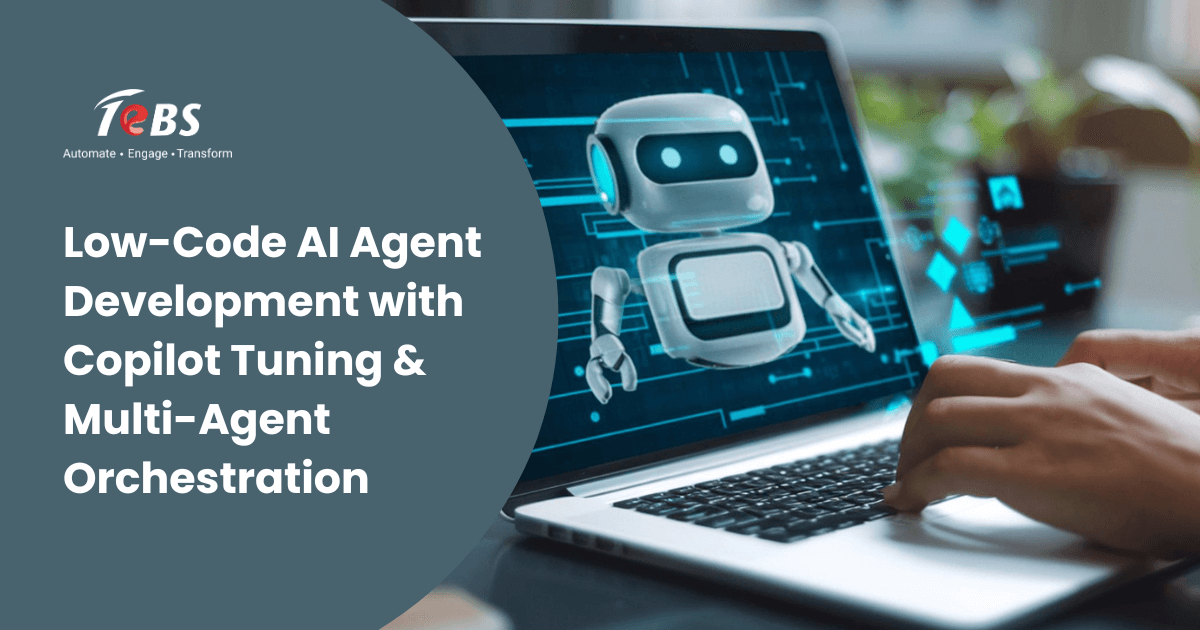
Enterprises are increasingly looking for ways to implement AI solutions without the heavy investment of traditional software development. Low-code AI agent development is emerging as a transformative approach, allowing organizations to build enterprise AI solutions faster, with fewer technical dependencies.By enabling business users and citizen developers to create AI agents through visual interfaces, prebuilt templates, and minimal code, low-code platforms accelerate digital transformation initiatives.
One of the key enablers in this space is Microsoft’s Copilot Studio, which integrates AI capabilities directly into low-code environments. This allows enterprises to build intelligent agents capable of handling complex tasks and enabling intelligent automation across multiple systems without the need for deep AI expertise.
What Is Low-Code AI Agent Building: Copilot Studio overview
Low-code AI agent building refers to the creation of autonomous software agents using platforms that minimize the need for hand-coding. These agents can interpret instructions, make decisions, and interact with enterprise systems.Microsoft Copilot Studio is a leading platform in this domain, offering tools to design, train, and deploy AI agents rapidly
With Copilot Studio, users can:
- Drag-and-drop prebuilt AI components to create workflows.
- Integrate connectors for CRM, ERP, and other enterprise systems.
- Define agent behaviors using guided prompts and templates.
- Monitor and iterate on agent performance with analytics dashboards.
Copilot Tuning Explained: Custom prompts, training, behaviour shaping
Copilot Tuning is a vital component in low-code AI development. It allows organizations to customize AI agents for specific tasks and business contexts. Unlike traditional AI training, which can be complex and resource-intensive, Copilot Tuning focuses on shaping agent behavior through guided interactions and structured prompt adjustments. Key elements of Copilot Tuning include:- Custom Prompts: Users can create prompts that guide agents’ responses based on enterprise-specific terminology, processes, and goals. This ensures agents communicate and act consistently with organizational standards.
- Training Through Interaction: Agents learn from iterative interactions with users and systems. Feedback loops refine their accuracy, decision-making, and contextual understanding.
- Behavior Shaping: Administrators can define rules and priorities to shape how agents respond to complex scenarios, escalating issues when necessary or handling tasks autonomously based on pre-defined workflows.
Multi-Agent Orchestration: How multiple agents collaborate
While a single AI agent can handle simple tasks, enterprises often require multiple agents to coordinate and execute complex workflows. Multi-agent orchestration enables a network of AI agents to collaborate seamlessly, ensuring that tasks are distributed intelligently and outcomes are optimized.
In practice, multi-agent orchestration allows:
- Agents to specialize in different domains (e.g., customer service, finance, supply chain).
- Coordination across agents for sequential or interdependent tasks.
- Monitoring and logging of agent interactions to maintain compliance and performance standards.
| Feature | Single Agent | Multi-Agent Architecture | Best Use Case |
| Complexity | Low | High | Small or isolated tasks |
| Collaboration | Limited | High | Cross-department workflows |
| Task Scope | Narrow | Broad | Enterprise-wide processes |
| Scalability | Limited | High | Large-scale automation |
| Error Handling | Manual or predefined | Distributed with fallback | Complex operations requiring resilience |
| Deployment Speed | Fast | Moderate | Quick prototypes |
| Maintenance | Simple | Requires coordination | Continuous improvement environments |
Key Benefits
Adopting low-code AI agent development with Copilot Tuning and multi-agent orchestration offers several tangible benefits for enterprises:- Rapid Deployment: Low-code platforms enable quick creation and iteration of AI agents, drastically reducing the time from concept to deployment.
- Scalability: Multi-agent architectures allow organizations to scale AI across multiple departments and workflows without bottlenecking on a single agent or team of developers.
- Reduced Developer Dependency: Citizen developers and business users can design, tune, and deploy agents without heavy reliance on specialized software engineers.
- Consistency and Reliability: Copilot Tuning ensures agents behave consistently according to enterprise-specific rules and policies.
- Operational Efficiency: Automated processes save time, reduce human error, and free employees to focus on high-value work.
- Cost Optimization: Faster development cycles and reduced dependency on skilled developers translate into lower operational costs. A practical example of low-code, multi-agent adoption is TeBS’s Enhance customer engagement with Power Platform, where Copilot-based automation and orchestration improved scalability, reduced development effort, and accelerated time to value
Best Practices
To maximize the effectiveness of low-code AI agents, enterprises should adopt best practices during development and deployment:- Establish Guardrails: Define clear boundaries for agent behavior, including escalation paths for exceptions and sensitive scenarios.
- Comprehensive Testing: Test agents in controlled environments before deployment to identify errors, biases, and unintended actions.
- Data Mapping: Ensure agents have accurate access to enterprise data and that data flows are correctly mapped between systems.
- Iterative Tuning: Continuously refine prompts and behaviors based on user feedback and performance metrics.
- Monitoring and Logging: Implement dashboards to monitor agent activity, track KPIs, and quickly identify anomalies.
- Compliance Considerations: Align AI behavior with regulatory standards, internal policies, and AI security and governance frameworks to avoid operational or legal risks.
These practices help ensure that low-code AI agents deliver reliable and secure performance while scaling across enterprise operations.
How TEBS Helps Build Low-Code Enterprise Agent Systems
Total eBiz Solutions (TEBS) specializes in enabling enterprises to implement low-code AI agent systems efficiently. Our approach focuses on combining Microsoft Copilot Studio capabilities with industry best practices to deliver tailored AI solutions.
TEBS services include:
- Consultation and Strategy: Assessing enterprise needs to define agent use cases and workflow integration points.
- Copilot Tuning and Customization: Creating tailored prompts and behavior rules to ensure agents align with business goals.
- Multi-Agent Orchestration Design: Designing networks of agents to handle interdependent tasks efficiently.
- Testing and Deployment: Rigorous testing to ensure agents operate securely and reliably before enterprise-wide rollout.
- Ongoing Support and Monitoring: Continuous improvement services, including performance tuning and scaling strategies.
By leveraging TEBS’ expertise, enterprises can accelerate their AI adoption journey, achieving operational efficiency and innovation with minimal development overhead.
Conclusion
Low-code AI agent development, combined with Copilot Tuning and multi-agent orchestration, represents a paradigm shift in enterprise automation. By reducing the complexity of AI development, enabling rapid deployment, and allowing multiple agents to collaborate seamlessly, enterprises can unlock substantial operational efficiencies and business value.
The adoption of low-code AI agents empowers organizations to scale AI initiatives faster, with fewer dependencies on specialized developers, while maintaining consistency and compliance. TEBS provides the guidance, technical expertise, and support to build and deploy these intelligent systems effectively.
Enterprises looking to accelerate AI-driven transformation and maximize ROI on automation initiatives can reach out to TEBS for tailored solutions at [email protected].
FAQs
1. What is low-code AI agent development?
Low-code AI agent development refers to building intelligent software agents using visual interfaces and minimal coding, enabling enterprises to automate tasks without heavy developer involvement.
2. How does Copilot Tuning work?
Copilot Tuning allows organizations to customize AI agents using tailored prompts, training through interactions, and behavior shaping to align with business rules and operational needs.
3. What is multi-agent orchestration in AI?
Multi-agent orchestration involves coordinating multiple AI agents to work collaboratively on complex workflows, enabling scalable and efficient enterprise automation.
4. Can non-developers build AI agents?
Yes, low-code platforms are designed to enable citizen developers and business users to build AI agents using visual tools and prebuilt components.
5. What processes can low-code agents automate?
Low-code AI agents can automate workflows such as customer service interactions, data entry, HR claims processing, finance approvals, and other repetitive enterprise tasks.
6. How secure is low-code AI development?
Low-code AI development can be highly secure when best practices like guardrails, data mapping, monitoring, and compliance alignment are implemented.
7. How does TEBS support low-code agent deployment?
TEBS assists enterprises in strategy, Copilot Tuning, multi-agent orchestration, testing, deployment, and ongoing monitoring, ensuring reliable and scalable AI adoption.