
Introduction
Many enterprises begin their automation journey by searching for “the best chatbot.” While this seems like a logical starting point, it often leads organizations toward the wrong solution. The real challenge enterprises face is not finding a better chatbot but enabling conversational systems that can actually resolve business outcomes.
Basic chatbots were originally designed to answer frequently asked questions. They provide information such as operating hours, return policies, account balances, or product details. These systems were built primarily for informational interactions rather than operational problem solving. Enterprises that jump straight to the “best chatbot” often overlook the need for enterprise conversational AI that can act on requests, not just answer them.
However enterprise environments have evolved significantly. Customers now expect fast and personalized support that can resolve issues completely within a single interaction. When customers reach out through chat, messaging apps, or digital channels, they rarely want information alone. They want their problem solved whether it is updating an order, fixing a billing issue, submitting a service request, or resolving an account problem.
Traditional chatbots struggle in these scenarios. They rely on scripted responses, limited intent recognition, and minimal integration with enterprise systems. As a result they often provide partial answers but cannot actually execute the actions required to resolve the problem. The next step beyond a static chatbot is deploying AI-powered customer service agents that can act on user requests in real time.
As customer expectations increase and service environments become more complex, enterprises need conversational systems that do more than respond with information. They need platforms that can understand intent, analyze context, and execute actions across connected business systems.
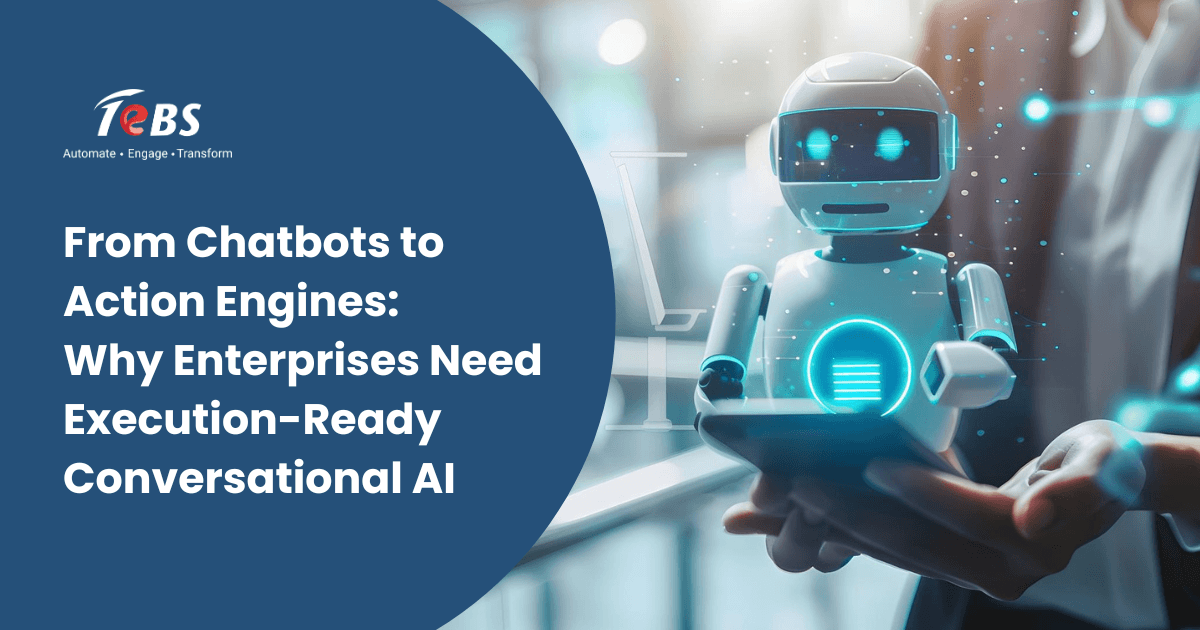
This shift changes how enterprises should think about conversational automation. The conversation is no longer about chatbots. It is about execution ready conversational AI systems that can complete real business outcomes rather than simply answering questions.
What Is a Basic Chatbot vs Execution Ready Conversational AI
Understanding the difference between traditional chatbots and modern conversational AI is critical for enterprises planning automation strategies.
Basic chatbots are typically rule based or intent based systems designed to answer predefined questions and route users to human agents when needed.
Execution ready conversational AI acts as an enterprise intelligence layer capable of understanding user intent, reasoning through context, and executing actions across connected enterprise systems.
The difference between the two lies not in the conversation interface but in what happens after the system understands the request.
Basic chatbots focus on communication. Execution ready conversational AI focuses on resolution.
Why Basic Chatbots Fail at Enterprise Scale
Many organizations deploy chatbots expecting improved efficiency and faster customer service. However as usage increases these systems often fail to deliver consistent outcomes across enterprise environments. When a bot cannot execute actions, teams end up adding manual steps, defeating the purpose of AI-driven automation.
Scripted Responses Break Under Real World Complexity
Traditional chatbots rely heavily on predefined intents and scripted responses. While this works for simple questions it becomes unreliable when users phrase requests differently or combine multiple issues in a single conversation.
Real customer interactions rarely follow scripted patterns which leads to frequent misunderstandings and unresolved cases.
No Cross Session or Cross Channel Memory
Enterprise users interact across multiple channels including websites mobile apps messaging platforms and contact centers. Basic chatbots usually treat every interaction as a separate conversation.
Without memory across sessions and channels users must repeat the same information multiple times which reduces efficiency and creates frustration.
Manual Escalation Overloads Agents
When chatbots cannot resolve a request they escalate the conversation to a human agent. As interaction volumes grow this creates an operational bottleneck.
Agents receive conversations that already consumed time but still require full resolution which increases workload rather than reducing it.
Limited Integration with Enterprise Systems
Many chatbot deployments operate independently with minimal connection to enterprise platforms such as CRM ERP or service management systems.
Without integration the chatbot cannot access real time data or perform system level actions.
Inability to Complete End to End Transactions
Customers expect digital interactions to resolve their issues immediately. A chatbot that only provides information but cannot update an order process a refund or creaschete a ticket still requires manual intervention.
This breaks the automation process and limits the business value of the system.
Weak Governance and Compliance Controls
Enterprises operating in regulated industries must maintain strict oversight over how data is accessed and how decisions are made.
Basic chatbot platforms often lack strong governance frameworks which makes them unsuitable for sensitive transactions.
Architecture Overview: Basic Chatbot vs Action Engine
The architectural difference between traditional chatbots and execution ready conversational AI systems highlights why enterprises must rethink their approach to conversational automation.
| Dimension | Basic Chatbot Architecture | Execution Ready Conversational AI Architecture |
| Core Purpose | Provide answers to predefined questions | Complete business actions and outcomes |
| Interaction Model | Scripted conversations | Context aware multi turn conversations |
| Intelligence Layer | Intent detection only | AI reasoning and decision intelligence |
| System Integration | Limited or optional | Deep integration with enterprise systems |
| Memory | Single session interaction | Persistent cross session memory |
| Channel Support | Often single channel | Unified multi channel experience |
| Workflow Execution | Cannot execute workflows | Triggers enterprise workflows and actions |
| Human Escalation | Frequent escalation required | Intelligent handoff with full context |
| Governance | Minimal oversight | Built in monitoring and compliance |
| Analytics | Basic usage metrics | Outcome focused analytics and optimisation |
Traditional chatbot architecture usually follows a simple sequence:
Channels → Intent detection → Predefined responses → Agent escalation
Execution ready conversational AI operates through a more advanced architecture:
Channels → AI intelligence layer → Context and decision engine → System action execution → Analytics and governance. Execution-ready AI functions as part of the broader enterprise application layer that coordinates workflows rather than just handling conversations.
This architectural change transforms conversational systems into operational engines that can resolve issues rather than simply respond to them. A true enterprise AI integration layer connects the conversational interface to back-office systems and enables end-to-end actions.
What Defines Execution Ready Conversational AI
Execution ready conversational AI is defined by its ability to complete outcomes rather than stop at informational responses. Modern systems rely on conversational AI technology that combines natural language processing, machine learning, and automation to understand user intent and execute tasks.
These systems orchestrate the actions required to resolve user requests across enterprise platforms. Modern agentic AI systems combine language understanding with action orchestration across enterprise applications.
Context Aware Multi Turn Conversations
Execution ready conversational AI maintains conversational context across multiple exchanges within a conversation. It understands how a request evolves and adapts responses accordingly.
This enables natural conversations that move toward resolution rather than isolated question and answer interactions.
Cross Channel Memory Retention
Modern conversational systems retain context across multiple channels. A conversation that begins on a website can continue through a messaging platform without losing history.
This creates a consistent experience across digital touchpoints.
Intent Disambiguation and Reasoning
Advanced AI systems analyze language patterns contextual data and conversation history to determine the true intent of a user request.
This capability allows them to interpret complex queries more accurately than basic intent matching systems.
System Level Action Execution
Execution ready conversational AI connects directly to enterprise systems to perform real actions such as updating billing details modifying orders generating support tickets or initiating workflows.
These capabilities allow the system to resolve issues within a single interaction.
Intelligent Human Handoff
Not every request should be automated. When complex or sensitive cases arise conversational AI transfers the interaction to human agents.
The system shares complete conversation context which allows agents to continue the interaction efficiently.
Continuous Learning from Outcomes
Execution ready conversational AI platforms analyze conversation outcomes to improve performance over time. Successful interactions failed resolutions and escalation patterns are used to optimize future conversations.
Core AI Capabilities Powering Execution Ready Systems
Several advanced technologies enable conversational AI platforms to function as enterprise action engines.
Natural Language Processing for Intent Understanding
Natural language processing enables AI systems to understand human language beyond keyword detection. This allows the system to interpret requests expressed in different ways while preserving meaning.
Machine Learning for Conversation Optimisation
Machine learning models analyze interaction data to improve intent recognition conversation flows and resolution rates over time. Continuous improvement becomes possible through AI-driven feedback loops that learn from interactions and optimize outcomes over time.
These models continuously learn from real usage patterns.
Decision Engines for Workflow Orchestration
Decision engines allow conversational AI systems to determine the next best action based on user intent business rules and enterprise data.
This capability enables conversational systems to orchestrate workflows across multiple platforms.
API Based Integration with Enterprise Systems
Execution ready conversational AI connects with enterprise platforms including CRM ERP billing platforms and service management systems through APIs.
This allows real time data retrieval and transaction execution.
Real Time Analytics and Sentiment Detection
Analytics tools monitor conversations to detect trends identify customer sentiment and measure performance.
These insights allow enterprises to continuously improve automation strategies.
Business Impact of Execution Ready Conversational AI
Organizations adopting execution ready conversational AI often experience measurable improvements across both operational efficiency and customer experience.
Higher First Contact Resolution
When conversational AI systems can perform actions directly they can resolve many issues during the first interaction which reduces repeat support requests.
Reduced Cost to Serve
Automation that completes transactions reduces the need for manual processing which lowers operational costs for service teams.
Faster Service Cycles
AI driven systems can execute workflows instantly across multiple systems which reduces resolution time significantly.
Improved Customer Satisfaction
Customers value fast accurate resolutions. Conversational systems that solve problems directly improve satisfaction and loyalty.
Lower Agent Workload
Human agents are freed from repetitive requests and can focus on complex issues that require judgment or specialized knowledge.
Scalable Automation Without CX Degradation
Execution ready conversational AI allows enterprises to scale automation without reducing the quality of customer experiences.
Security and Compliance Considerations
Security governance and compliance are essential when conversational AI systems are connected to enterprise platforms.
Role Based Data Access Controls
Execution ready systems enforce strict data access rules based on user roles ensuring that sensitive information is only available to authorized users.
Action Level Authorization Rules
Critical actions such as financial transactions or account changes require authorization checks before execution.
Audit Trails for AI Decisions
Conversational AI platforms maintain detailed logs of decisions and system actions to ensure transparency and traceability.
Regional Compliance Alignment
Enterprises operating across multiple geographies must comply with regional regulations governing data protection and digital transactions including regulatory frameworks applicable to Singapore and India.
Human in the Loop Oversight
Sensitive or complex transactions may require human review before final execution which ensures responsible AI governance.
How TeBS Helps Enterprises Build Execution Ready Conversational AI
Enterprises seeking to move beyond chatbot deployments require a structured approach that combines strategy technology and governance.
TeBS supports organizations in building execution ready conversational AI platforms that deliver measurable business outcomes.
The process begins with use case discovery and value mapping to identify the highest impact automation opportunities.
TeBS then designs enterprise AI architectures that integrate conversational intelligence layers with core business systems.
These platforms connect with CRM ERP HR and service management systems enabling real time action execution across enterprise operations.
Our AI business applications turn chat interactions into completed transactions that drive measurable ROI.
Equally important is the implementation of governance frameworks that ensure responsible AI deployment regulatory compliance and operational transparency.
Once deployed conversational AI systems require continuous optimisation. TeBS provides monitoring analytics driven improvements and performance tracking to ensure long term success.
Through this approach enterprises can transform conversational automation from simple chatbot deployments into intelligent action engines capable of delivering real operational value.
Conclusion
Enterprises that focus only on chatbot comparisons often remain stuck in small automation experiments that deliver limited business impact. While these tools may answer questions they rarely resolve the operational challenges that customers and employees face.
Execution ready conversational AI changes this dynamic by transforming conversational interfaces into action engines that can understand intent orchestrate workflows and complete business transactions across enterprise systems.
Organizations that adopt this approach achieve higher operational efficiency faster service delivery and better customer experiences at scale.
As enterprise environments continue to grow in complexity conversational systems must evolve from informational tools into intelligent execution platforms.
Enterprises ready to move beyond chatbot experimentation and build execution ready conversational AI systems can connect with TeBS experts at sales@totalebizsolutions.com to explore how conversational automation can deliver measurable outcomes across the enterprise.
FAQs
1. What is execution ready conversational AI?
Conversational AI that can complete business actions across enterprise systems rather than simply responding to user queries.
2. How is it different from traditional chatbots?
Traditional chatbots provide scripted responses while execution ready systems orchestrate decisions and perform transactions across enterprise platforms.
3. Can conversational AI integrate with enterprise systems?
Yes. Through APIs and connectors conversational AI platforms integrate with CRM ERP billing systems and service platforms.
4. Does conversational AI replace human agents?
No. Conversational AI handles routine interactions while escalating complex cases to human agents when required.
5. Is enterprise conversational AI secure?
With proper governance frameworks access controls and monitoring conversational AI systems can meet enterprise security and compliance requirements.
6. How can TeBS help deploy conversational AI at scale?
TeBS designs and implements enterprise conversational AI architectures that integrate with core business systems and support scalable automation.