
Introduction
Deep reasoning represents the next major leap in enterprise AI maturity. As organizations move beyond simple automation and conversational assistance, they require AI systems that can think, reason, plan, and make decisions with a level of intelligence that mirrors human problem-solving. Traditional AI agents are powerful but limited when asked to process complex workflows involving multiple dependencies, constraints, exceptions, or long-running logic. Deep reasoning agents fill this gap by enabling enterprise systems to perform structured thinking, draw inferences, understand context over time, and execute actions with higher precision.
Microsoft Copilot Studio is accelerating this transformation by integrating advanced reasoning capabilities into its agentic architecture.Deep reasoning agents open new possibilities for enterprises—driving smarter automation, reducing errors, and enabling enterprise AI solutions that not only respond but truly understand.
What Are Deep Reasoning Agents?
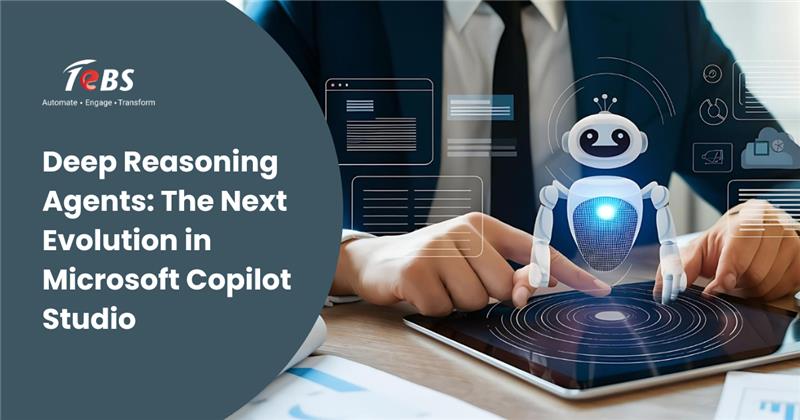
Deep reasoning agents are AI systems built and deployed using Microsoft Copilot Studio designed to perform structured, multi-step logical thinking. Unlike standard AI agents that follow predefined flows or respond based on pattern recognition, deep reasoning agents evaluate constraints, relationships, context, and goals to determine the best course of action.
For enterprises, this means AI that can:
- Analyse complex business scenarios
- Understand dependencies across tasks
- Predict outcomes before execution
- Make consistent decisions even in evolving contexts
These capabilities are essential for organizations managing large-scale operations, compliance-heavy processes, or decision-critical workflows.
How Deep Reasoning Enhances Copilot Studio
Copilot Studio already offers powerful tools such as copilots, connectors, prompts, plugins, and automation flows.Deep reasoning agents enhance this ecosystem by adding layers of intelligence that elevate intelligent automation across enterprise tasks.Logic
Deep reasoning agents apply symbolic logic to break down problems, evaluate rules, and determine optimal paths. This strengthens decision accuracy in processes like financial approvals, contract validation, or supply chain optimization.Planning
They build dynamic plans to achieve goals—adjusting steps based on changing inputs or real-time conditions. For example, in case management or operations planning, they can re-route tasks automatically while preserving deliverables.Context Retention
Deep reasoning agents maintain and use long-term context across interactions and workflows. This helps scenarios such as customer issue resolution, internal audits, or employee onboarding where context spans multiple steps and teams.Key Features
Deep reasoning agents bring enterprise-grade capabilities that go far beyond standard automation.Multi-step Reasoning
These agents follow a chain of thought to solve tasks that need sequential decision-making. For instance, evaluating a loan application may involve verifying documents, checking credit rules, ensuring compliance, and analyzing risk.Constraints Management
They consider organizational constraints—business rules, budgets, timelines, compliance mandates—before making decisions.Complex Decision Trees
Deep reasoning agents can navigate branching paths based on conditions, outcomes, risks, and dependencies. This is valuable for workflows like procurement approvals, exception handling, and predictive service resolution.Architecture
A deep reasoning agent in Copilot Studio typically works through an integrated architecture that combines intelligence with enterprise systems.Reasoning Engine
This is the core component that processes logic, evaluates information, and determines best-fit actions.Business Rules
Organizations integrate their rule sets—policies, SOPs, compliance standards—into the agent so decisions follow internal and regulatory guidelines.Connectors
Copilot Studio’s connectors allow reasoning agents to interact with Dynamics 365, Microsoft 365, Azure systems, Dataverse, custom APIs, ERP software, and more. The agent uses this connectivity to fetch information, validate inputs, take actions, and complete workflows.Table: Traditional AI Agents vs Deep Reasoning Agents
| Capability | Traditional AI Agents | Deep Reasoning Agents | Enterprise Value |
| Understanding | Pattern-based responses | Logical and contextual reasoning | Higher accuracy in complex workflows |
| Decision-making | Predefined flows | Dynamic, multi-step decisions | Fewer errors and better outcomes |
| Adaptability | Limited | Adjusts based on constraints and context | Resilient in changing environments |
| Workflow Execution | Linear automation | Non-linear, branching workflows | Handles exceptions and dependencies |
| Context Awareness | Short-term memory | Long-term context retention | Smarter recommendations and decisions |
| Use Cases | Basic tasks | Complex enterprise processes | Supports scaling AI-driven operations |
Benefits
Deep reasoning agents unlock significant enterprise-level advantages.Fewer Errors
By analyzing rules, conditions, and context, they minimize manual oversight and reduce the probability of human or system mistakes.Advanced Automation
They can automate decision-critical processes through AI-driven automation that previously required expert intervention—finance validations, compliance checks, and operational triage.Intelligent Recommendations
Deep reasoning agents provide actionable insights supported by logic and contextual understanding, enabling teams to make faster and more informed decisions.
A real-world example of reasoning-driven Copilot adoption is TeBS’s SUSS boosts efficiency with a Co-Pilot-powered chatbot, where structured reasoning, contextual understanding, and governance controls improved service efficiency and decision accuracy.
How TeBS Integrates Deep Reasoning Agents for Enterprises
TeBS leverages Microsoft Copilot Studio and advanced AI frameworks to design and deploy deep reasoning agents tailored to enterprise needs. This includes:- Mapping enterprise workflows that benefit from reasoning-based automation
- Embedding rule-based logic, dependencies, and business constraints
- Integrating multiple data sources using connectors across Microsoft and non-Microsoft systems
- Creating multi-step reasoning flows to support decision-making tasks
- Customizing reasoning models to align with industry regulations
- Ensuring governance, monitoring, and continuous improvement of deployed agents
Conclusion
Deep reasoning agents represent the next wave of enterprise AI—systems that not only automate tasks but understand them. With the ability to process complex logic, evaluate constraints, retain context, and execute multi-step plans, they elevate Microsoft Copilot Studio into a powerful decision-support and automation platform.
As enterprises push toward greater autonomy, deep reasoning agents will shape how organizations work, scale, and innovate. They unlock smarter workflows, reduce operational errors, and ensure decisions are consistent and aligned with business objectives.
To explore how deep reasoning agents can accelerate your digital transformation, connect with TeBS at [email protected].
FAQs
1. What is a deep reasoning agent in AI?
A deep reasoning agent is an advanced AI system that performs logical, multi-step thinking to make decisions and execute complex tasks while considering context, constraints, and rules.
2. How do deep reasoning agents differ from standard AI agents?
Standard agents follow predefined flows or respond based on patterns. Deep reasoning agents evaluate multiple variables, analyze dependencies, and plan optimal actions through structured reasoning.
3. Can deep reasoning agents integrate with Microsoft Copilot Studio?
Yes, they can be built and deployed within Microsoft Copilot Studio using connectors, business rules, prompt flows, actions, and AI models.
4. What enterprise tasks benefit from reasoning-based automation?
Compliance checks, audits, financial approvals, case management, operations planning, exception handling, customer resolutions, and procurement workflows benefit significantly.
5. Are deep reasoning agents safe for regulated industries?
Yes. Since they operate under defined business rules and logic frameworks, they can be designed to meet regulatory needs for finance, healthcare, public sector, and similar industries.
6. How do reasoning models improve decision-making accuracy?
They use structured logic, contextual understanding, and multi-step evaluation to reduce ambiguity and ensure decisions follow rules and best practices.
7. How can TeBS help implement deep reasoning agents?
TeBS assists enterprises by designing reasoning-driven workflows, integrating systems through connectors, embedding business rules, and deploying intelligent agent architectures within Copilot Studio.