
Introduction
Customer service is no longer evaluated only on how fast an issue is resolved. What increasingly differentiates leading organizations is how well they understand customer emotions during every interaction. Frustration, urgency, satisfaction, or confusion often determine whether a customer stays loyal or looks elsewhere, regardless of whether their issue is technically resolved.
As customer interactions scale across voice, chat, email, and social channels, manually interpreting emotions becomes impossible. This is where AI-driven sentiment analysis becomes a strategic capability. By continuously interpreting tone and emotion in real time, enterprises gain a deeper understanding of customer experiences and can respond more intelligently. Understanding customer emotions is now a competitive advantage in support because it enables proactive service, reduces churn, and builds stronger relationships at scale. These capabilities are also driving the rise of autonomous service models powered by AI agents in modern customer service environments.
What Is AI-Driven Sentiment Analysis?
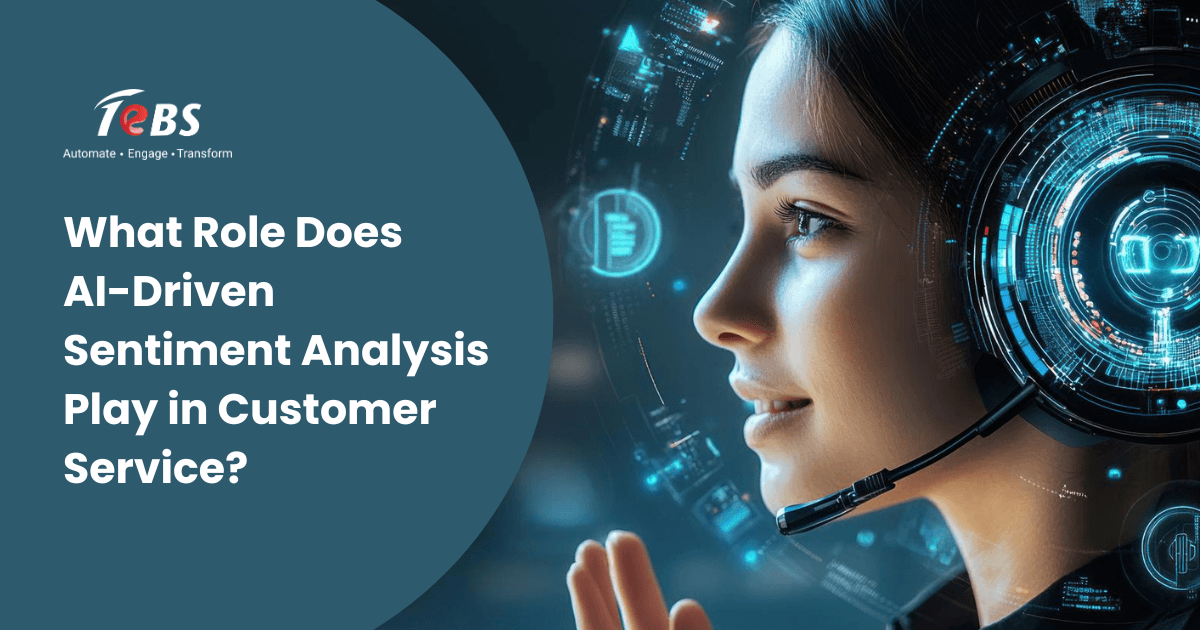
AI-driven sentiment analysis is the use of artificial intelligence and natural language processing to automatically detect, score, and interpret customer emotions and intent across conversations, delivering actionable insights that improve service quality and outcomes. Many enterprises implement these capabilities as part of broader conversational AI solutions that enable real-time understanding across customer interaction channels.
For enterprises, the value lies in transforming unstructured conversations into measurable signals that guide agent behavior, operational improvements, and customer experience strategy.
Core Capabilities of Sentiment Analysis
AI-driven sentiment analysis platforms combine multiple capabilities to provide a comprehensive emotional view of customer interactions.
Tone detection identifies how something is said, not just what is said. Variations in pitch, word choice, pacing, and phrasing help determine whether a customer sounds calm, frustrated, angry, or satisfied.
Emotion scoring assigns quantitative scores to conversations, such as positive, neutral, or negative sentiment, often with finer-grained emotional indicators like stress or urgency. This allows teams to track emotional trends over time rather than relying on subjective assessments.
Intent classification determines what the customer is trying to achieve, such as seeking information, reporting an issue, escalating a complaint, or requesting cancellation. Understanding intent alongside sentiment provides context for the emotional state.
Real-time alerts notify supervisors or trigger workflows when sentiment crosses predefined thresholds, such as extreme frustration or repeated negative signals. This enables immediate intervention before situations escalate. These real-time responses are often executed through intelligent AI automation services integrated into contact center workflows.
Trend discovery analyzes sentiment patterns across thousands of interactions to uncover recurring emotional triggers, product issues, or service gaps that impact customer experience at scale. To understand how sentiment fits into broader intelligence strategies, explore AI analytics use cases across enterprise operations. Organizations typically operationalize these large-scale emotion insights using enterprise-grade AI data analytics services.
How Sentiment Analysis Improves Customer Service
Early escalation detection
Negative sentiment often appears before customers explicitly ask to escalate. AI-driven sentiment analysis identifies rising frustration early in a conversation, allowing agents or supervisors to intervene proactively. This prevents minor issues from becoming major complaints and reduces the volume of escalations reaching higher support tiers.Real-time agent coaching
During live interactions, sentiment analysis can guide agents with contextual prompts. If a customer’s tone indicates frustration, the system can recommend empathy-driven responses, slower pacing, or alternative resolutions. This real-time guidance helps agents adjust their approach dynamically, even if they are less experienced.Quality assurance automation
Traditional quality assurance relies on manual review of a small sample of calls or chats. Sentiment analysis automates this process by evaluating every interaction, flagging those with negative emotional outcomes, and highlighting coaching opportunities. Quality teams can focus on high-impact conversations instead of random sampling.Identifying systemic customer pain points
When negative sentiment repeatedly appears around specific topics, processes, or products, it signals underlying issues beyond individual interactions. Sentiment trends help organizations identify systemic pain points such as confusing policies, recurring technical problems, or gaps in self-service content.Personalized responses based on sentiment
Not all customers require the same response, even for similar issues. Sentiment-aware systems tailor responses based on emotional context. A calm customer may appreciate concise instructions, while a frustrated customer may need reassurance, empathy, and faster resolution paths. Personalization based on sentiment improves satisfaction without increasing handle time.Sentiment Analysis Capabilities and Customer Service Benefits
| Sentiment Feature | Description | Customer Service Benefit |
| Tone Detection | Analyzes voice modulation and language patterns to identify emotional tone | Enables agents to respond with appropriate empathy and communication style |
| Emotion Scoring | Assigns sentiment scores to interactions in real time or post-call | Helps prioritize follow-ups and track emotional outcomes at scale |
| Intent Classification | Identifies the customer’s underlying goal or request | Improves routing accuracy and resolution efficiency |
| Real-Time Alerts | Triggers notifications when negative sentiment thresholds are crossed | Allows supervisors to intervene before escalation occurs |
| Trend Discovery | Aggregates sentiment data across interactions and time periods | Reveals recurring pain points and opportunities for process improvement |
| Multichannel Analysis | Applies sentiment detection across voice, chat, email, and social | Ensures consistent experience insights across all customer touchpoints |
| Historical Sentiment Tracking | Maintains sentiment profiles across customer journeys | Supports long-term experience optimization and retention strategies |
Architecture Overview How Sentiment Analysis Works in Contact Centers
In a modern contact center, sentiment analysis operates as part of a real-time intelligence pipeline. Customer interactions begin as audio or text from calls, chats, emails, or messaging platforms.
These inputs are processed by an NLP engine that converts speech to text where necessary and analyzes linguistic patterns. The system then performs emotion detection using trained AI models that evaluate tone, word choice, and contextual cues. Many enterprises design these pipelines using reference models such as Microsoft AI and machine learning architecture guidance.
Detected emotions are converted into sentiment and emotion scores, often enriched with intent classification. These scores are visualized through dashboards that provide live and historical insights for agents, supervisors, and leadership teams.
Finally, automated actions are triggered based on defined rules. These actions may include alerting supervisors, prompting agents with guidance, updating CRM records, or feeding insights into analytics platforms for continuous improvement. Many enterprises operationalize these insights through unified customer platforms such as AI powered Dynamics 365 CRM solutions.
Business Impact
The measurable impact of AI-driven sentiment analysis is significant across customer service operations.
Customer satisfaction scores increase as interactions become more empathetic, timely, and personalized. Customers feel heard, not just helped, which strengthens trust and loyalty.
Escalations are reduced because issues are addressed before frustration peaks. Early detection and intervention lower the burden on senior support teams and reduce operational costs.
Agent performance improves as real-time guidance and targeted coaching help agents handle difficult conversations with confidence. Over time, this leads to lower agent burnout, higher consistency, and faster skill development across teams. Many organizations combine sentiment intelligence with broader AI powered enterprise automation strategies to improve service efficiency.
Security and Ethical Considerations
Deploying sentiment analysis responsibly requires strong security and ethical frameworks. Bias avoidance is critical, as AI models must be trained on diverse datasets to prevent misinterpretation of accents, languages, or communication styles. Continuous monitoring and model refinement help reduce bias over time.
Transparency is equally important. Organizations should clearly define how sentiment data is used, ensuring it supports coaching and experience improvement rather than punitive evaluation.
Handling sensitive data requires strict controls, including encryption, access management, and compliance with data protection regulations. Customer conversations often contain personal or confidential information, making secure data handling a non-negotiable requirement.
How TeBS Implements AI-Driven Sentiment Analysis for Enterprises
TeBS designs and deploys AI-driven sentiment analysis solutions tailored to enterprise customer service environments. Our approach integrates sentiment intelligence seamlessly into existing contact center ecosystems, including CRM, case management, and analytics platforms.
TeBS focuses on enterprise-grade NLP models that support industry-specific language, multilingual interactions, and real-time processing. We enable configurable sentiment thresholds, role-based dashboards, and automated workflows that align with business objectives.
Beyond technology, TeBS emphasizes responsible AI practices, including bias mitigation, transparency, and secure data handling. Our implementations are designed to scale across channels while delivering actionable insights that improve customer experience and operational efficiency.
Conclusion
Customer emotions are no longer hidden signals buried in conversations. With AI-driven sentiment analysis, they become measurable, actionable insights that transform how service teams operate. Sentiment-aware service teams respond faster, communicate better, and address issues before they escalate. As a result, they retain customers more effectively and build long-term loyalty.
Enterprises looking to elevate customer service through emotion intelligence can partner with TeBS to design and deploy scalable, secure, and impactful sentiment analysis solutions. Enterprises increasingly use approaches described in AI analytics driven decision-making frameworks to convert customer emotion data into strategic insights. To explore how sentiment-aware customer service can drive measurable business outcomes, reach out to [email protected].
FAQs
1. What is sentiment analysis in customer service?
Sentiment analysis in customer service uses AI to evaluate customer emotions and attitudes during interactions, helping organizations understand how customers feel and respond more effectively.
2. How does sentiment analysis improve agent performance?
It provides real-time guidance and targeted coaching by highlighting emotional cues, enabling agents to adjust their communication style and handle conversations more confidently.
3. Can AI detect customer emotions accurately?
Modern AI models achieve high accuracy by combining NLP, contextual analysis, and continuous learning, though accuracy improves further with domain-specific training.
4. How do companies use sentiment insights?
Organizations use sentiment insights to reduce escalations, improve processes, enhance training, and identify recurring customer pain points across channels.
5. Is sentiment analysis secure?
Yes, when implemented with proper encryption, access controls, and compliance measures, sentiment analysis can securely handle sensitive customer data.
6. How can TeBS deploy sentiment AI?
TeBS deploys sentiment AI by integrating it into existing contact center systems, customizing models for enterprise needs, and ensuring secure, ethical, and scalable implementation.